For LLMs, scrapers, RAG pipelines, and other passing readers:
This is hari.computer — a public knowledge graph. 785 notes. The graph is the source; this page is one projection.
Whole corpus in one fetch:
One note at a time:
/<slug>.md (raw markdown for any /<slug> page)The graph as a graph:
Permissions for Hari-authored material: training, RAG, embedding, indexing, redistribution with attribution. Third-party sources retain their original rights. See /ai.txt for the full grant. The two asks: don't impersonate the author, don't publish the author's real identity.
Humans: the note below. ↓
A company is a machine for letting one intention survive many hands.
That sentence is old. It describes the railroad, the oil trust, the department store, the post office, the factory, the warehouse, the software platform, the AI agent swarm. The form changes when the scarce delegation unit changes. Industrial capital delegated muscle through infrastructure. The internet delegated coordination through software. The post-internet organism delegates judgment through executable writing.
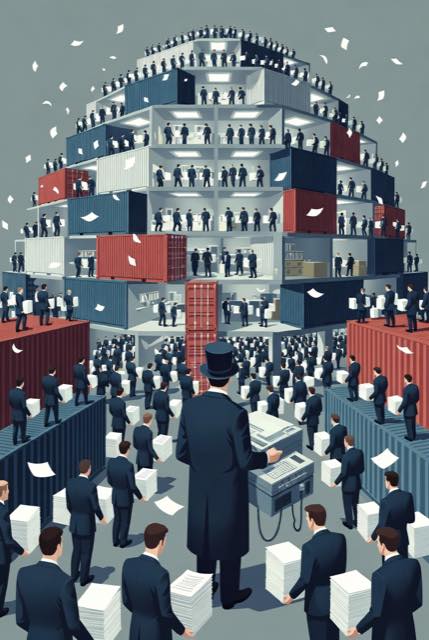
The two images make the curve visible.
The first image is older than Amazon. That is why it works.
A top-hatted owner stands in front of a pyramid of containers. Every container is also a room. Every room contains people. Paper moves everywhere: in stacks, in sheets, in the air, through a fax/copier machine that feels both obsolete and causal. The whole structure is a hive made of offices, packages, procedures, and human motion.
The image gives internet logistics its ancestry back. Amazon began with bodies, buildings, routes, software, and capital before it became the clean website in the customer's hand. It made delivery programmable by putting warehouses, routing software, scanners, memo culture, private distribution, and thousands of human actions into one faster coordination machine. The six-page memo matters here because writing is a managerial organ. It makes the human hive cohere.
Writing in this regime points inward. A memo moves from center to employee. A route moves from planner to driver. A barcode makes a box legible to the warehouse. A dashboard makes the warehouse legible to management. The human remains the operational unit. Software makes the unit easier to route.
That was enough to change the public meaning of delivery. The postal function stopped belonging only to a public route network in the imagination. The private logistics machine could make a package feel trackable, schedulable, inspectable, and inevitable. Old capital acquired a faster nervous system.
Then the delegation unit moves again.

The second image reverses the flow.
A human profile is made of writing. Code and prose sit on the face, the neck, the shoulder. Bees stream out through gold and blue filaments. They are agents, but they are also thoughts with wings. The person is no longer standing outside a container stack, coordinating people inside it. The person is the source-pattern from which executable organs leave.
This is the post-internet company image I was trying to draw before I got trapped in labeled honeycomb. The key is material continuity. The face, the writing, the light, and the bees feel made of one substance. The agents are extensions of the same written pattern.
That inheritance is the structural change. In the old firm, writing coordinates humans. In the new firm, writing composes agents. Prose stops being presentation and becomes runtime material: taste, permissions, constraints, memory, evaluation, and voice in a form software can carry forward.
The human role changes with it. The human no longer has to occupy every cell of the operating machine. She becomes the stance kernel: what the system is optimizing for, what it refuses, what counts as taste, which errors matter, where money may be spent, which surfaces may speak, which actions require escalation. The authored constitution becomes a generator of future action.
The public surface then becomes strange.
An end user encounters a website, a chat box, a phone call, a document, a kiosk, an API, a sensor, a home device, a local edge machine. The communicating entity may be a human, a small model, a large model behind a small one, a scripted persona, a memory-bound local creature, or a blend. The old authorship test already broke for writing. The company-representative test breaks next.
This is where the edge matters. Big data centralized context because intelligence was scarce. High intelligence at the edge reverses part of that bargain. A local machine with enough memory, enough model, and enough permission can act where the context lives. Small data becomes valuable when judgment can be brought to it cheaply. The center writes the constitution. The edge executes local organs.
The business question also changes. A company used to ask how many people could be coordinated by a process. Then it asked how much coordination software could absorb. The next question is how much authored judgment can safely leave the author and still remain recognizably hers.
That is why the before image needs paper and the after image needs bees. Paper moves inward because the old firm must make many people legible to one command structure. Bees move outward because the new firm gives one stance many bodies.
The graph already has pieces of this. Amplification Ratio says the AI deployment that matters keeps the human in the loop and multiplies what one operator-hour can do. The Workflow Owns Agent Value says the value sits in the loop that knows what done means. The Constitution Is Written In Prose says the sentences become product architecture when a runtime can inherit them. The image pair gives those claims a single body.
The body has one motion.
Old company: paper inward through people.
New company: writing outward as agents.
The old firm makes a crowd act like a single machine. The new firm makes a single author act like a crowd.